
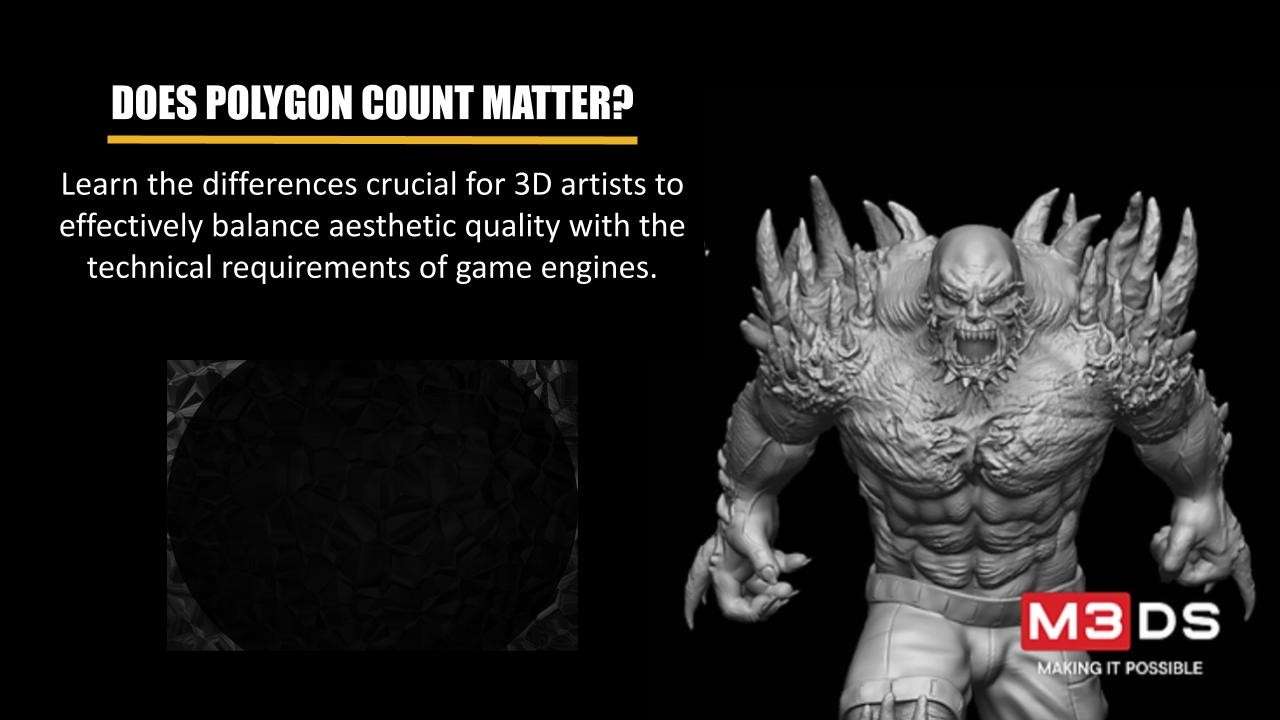

Polygon Count in 3D Modeling: Is It Valid for Game Assets?
Polygon count in 3D modeling plays a crucial role when creating game assets. The number of polygons used determines both the visual quality of a model and how efficiently it performs during gameplay. Understanding how to balance detail and performance is essential for creating optimized assets that look great without slowing down the game.
Why does polygon count matter? Polygon count directly affects the level of detail a 3D model can achieve and how smoothly it runs inside a game engine.
Finding the right balance: Game artists and developers constantly balance creating visually impressive assets with maintaining strong performance. Modern hardware and improved rendering techniques allow artists to work with higher polygon counts than ever before, but optimization remains essential.
Adapting to different platforms: A game running on a high-end PC has access to more processing power and memory than a mobile device. Artists must optimize assets so they perform well across different platforms while maintaining visual quality.
Evolving technology and techniques: New methods for managing polygon count continue to improve workflows. Staying updated with modern optimization techniques helps artists create assets that meet the demands of current consoles, computers, and mobile devices.
By understanding polygon management and applying smart optimization techniques, artists can create detailed game assets that perform efficiently across different systems.
What Is Polygon Count in 3D Modeling?
Polygon count refers to the number of polygonal faces used to create a 3D model. These polygons form the surface of an object and define its overall shape, structure, and level of detail.
How Do Polygons Work?
Polygons are created using vertices and edges. A vertex is a point in 3D space, while an edge is a line connecting two vertices. When multiple edges connect, they create a polygonal face.
The two most common polygon types used in 3D modeling are triangles and quads. For example, a simple cube contains six faces, twelve edges, and eight vertices.
Difference Between High-Poly and Low-Poly Models
High-poly models contain a large number of polygons, allowing artists to create realistic details and complex shapes. They are commonly used in film production, visual effects, and detailed asset creation.
Low-poly models use fewer polygons and are essential for real-time applications such as video games. Since game engines must render many objects simultaneously, optimized polygon counts help maintain smooth performance.
The process of converting detailed high-poly models into optimized versions is known as retopology. Artists use this technique to preserve visual quality while reducing unnecessary geometry.
Why Polygon Count Matters in Gaming and VFX
Polygon count is important across industries such as gaming, film, and visual effects. When assets are used across multiple platforms, including PCs, consoles, and mobile devices, controlling the amount of geometry helps maintain consistent performance and quality.


The Importance of Polygon Count in 3D Game Modeling
The Foundation of 3D Shapes: Triangles
Understanding the relationship between polygons and triangles is essential for creating optimized game assets. Although artists often work with different polygon types during modeling, game engines ultimately render models using triangles.
Triangles are the foundation of real-time rendering because their simple structure allows game engines to process models consistently and efficiently.
Modeling with Quads and Complex Polygons
While triangles are used during rendering, artists commonly prefer working with quads during the modeling process. Quads provide more flexibility when shaping surfaces, adding details, and creating smooth forms.
Many professional 3D modeling tools are designed around quad-based workflows because they allow artists to manipulate complex surfaces more efficiently.
Balancing Artistic Flexibility with Technical Efficiency
Game artists must carefully balance creative freedom with technical limitations. Even though artists may create models using quads and other polygon types, game engines eventually convert them into triangles.
Effective polygon management means creating visually impressive models while ensuring they remain optimized for real-time performance.
The Art of Strategic Polygon Use
Using polygons efficiently requires both artistic judgment and technical understanding. Well-planned geometry allows artists to create detailed assets that look impressive while maintaining smooth gameplay performance.
Polygons vs. Triangles in Game Asset Design
The relationship between polygons and triangles is essential in game asset creation. Each has different advantages depending on whether the focus is modeling, texturing, or rendering.
Basic Differences
Triangles are the simplest and most stable polygon type for game engines, making them ideal for reliable rendering. Quads and other complex polygons provide greater flexibility during modeling because they are easier to manipulate and refine.
During the rendering process, game engines convert complex polygons into triangles. This ensures compatibility, stability, and efficient performance in real-time environments.
Impact on Modeling and Texturing
- Triangles: Used by game engines for rendering because they provide consistent performance and stability.
- Polygons: Help artists create and edit detailed models more efficiently during the modeling process.
- Texturing: Polygon structure affects how easily textures can be created and adjusted before final optimization.
- Efficiency: Higher polygon counts increase detail but can reduce performance, making optimization essential.

Conclusion: Master Polygon Optimization for Game Development
Polygon count is one of the most important considerations in 3D game development. It influences both the appearance of assets and their performance inside a game engine.
By understanding the relationship between polygon density, optimization techniques, and platform limitations, artists can create detailed models that run smoothly across different devices.
Our academy programs cover polygon optimization, 3D modeling, and many other essential skills needed for professional game development. If you want to focus on a specific skill, explore our courses section.
We also offer masterclasses featuring insights from experienced industry professionals.
Learn more about available options through our enrollment and financing page, or join us today and start building your future in 3D art and game development.